
If you’ve ever wondered whether applying for the spring intake in USA is a smart move, the short answer is, yes, absolutely! The spring intake in USA opens doors to world-class education, greater flexibility, and improved chances of admission. Many international students think the Fall session is the only major intake, but the spring intake, also known as the January Intake, is equally powerful for those who want to kickstart their studies and future career without waiting another year.

In this guide, you’ll explore the seven powerful reasons why applying for the spring intake in USA can shape your academic journey for success. You’ll also discover top universities, admission timelines, and valuable application tips to help you prepare effectively.
Understanding the Spring Intake
Before diving into the reasons, let’s clarify what the spring intake means.
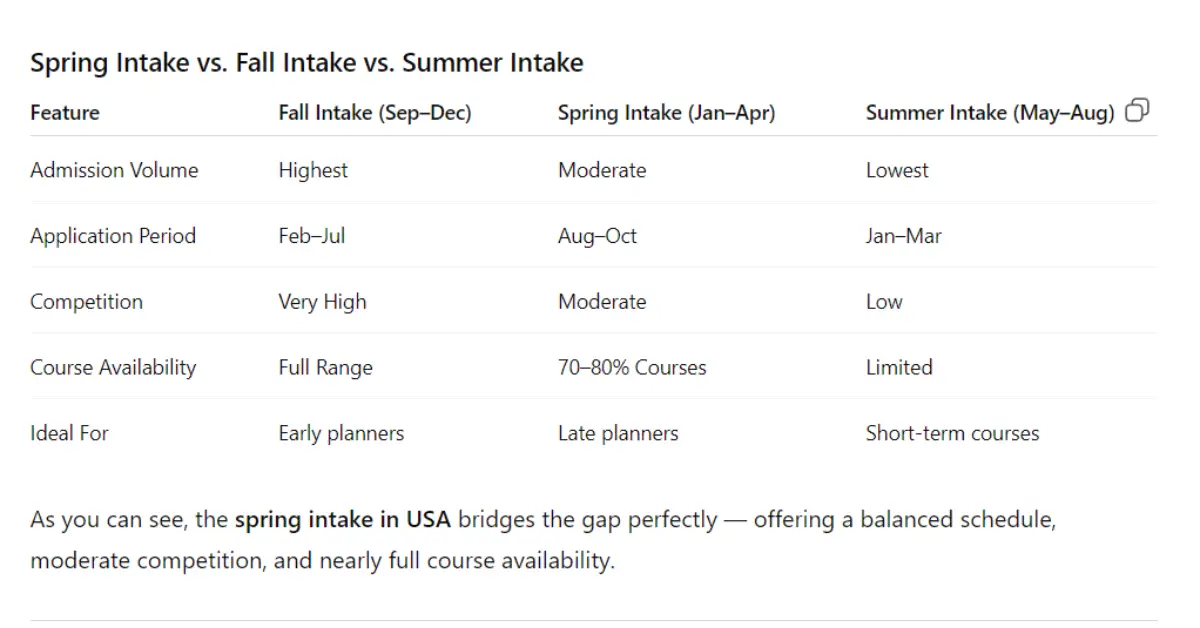
The spring intake in USA usually begins in January and continues until April. That’s why it’s often referred to as the January Intake by most universities. It serves as the second major admission cycle after the Fall session (September–December).
Unlike the Fall intake, where competition is fierce and deadlines are early, the spring intake offers a more relaxed and flexible timeline. It’s perfect for students who may have missed the Fall deadlines or need more time to prepare documents, exams, and finances.
7 Powerful Reasons to Apply for the Spring Intake in USA
The benefits of the spring intake in USA go far beyond just timing. It’s a strategic opportunity to begin your study abroad dream with flexibility, smaller class sizes, and better academic focus.
Let’s explore the 7 powerful reasons that make this intake ideal for your success.
1. Higher Acceptance Chances and Less Competition
One of the biggest advantages of the spring intake in USA is the lower competition compared to the Fall session. Since most international students aim for Fall, universities often receive a smaller number of applications during the spring intake, which directly increases your chance of admission.
This means:
- More personalized attention from admissions officers.
- Greater likelihood of acceptance, even if your profile isn’t perfect.
- Easier access to popular programs that fill up quickly during Fall.
Many universities intentionally reserve a percentage of seats for January Intake students to maintain balance across both sessions. So, if you want to increase your odds of getting into your dream program, the spring intake in USA gives you that edge.
2. Flexible Admission Timeline for Late Planners
If you missed the Fall deadline or needed extra time to prepare for English proficiency tests like IELTS or TOEFL, the spring intake is your best opportunity. It offers you additional months to improve your application, gather recommendation letters, refine your SOP, and secure financial documents.
This flexible timeline is especially helpful for:
- Students who decide late to study abroad.
- Applicants waiting for final exam results.
- Students who want more time to compare universities and programs.
The spring intake in USA ensures you don’t have to wait another full year to start your higher education journey. You can still begin in January and graduate on time with careful planning.
3. Early Graduation and Career Advantage
Starting your studies during the January Intake can help you graduate earlier or on time with your peers. Most universities in the spring intake in USA allow students to take summer courses, which can shorten the overall duration of the degree.
This early completion offers a career advantage:
- Enter the job market ahead of the crowd.
- Apply early for Optional Practical Training (OPT) or internships.
- Gain professional experience before Fall graduates even complete their studies.
By the time other students are applying for jobs, you’ll already have valuable U.S. experience under your belt — a crucial factor for global employability.
4. Smaller Class Sizes and Better Learning Environment
Another major benefit of the spring intake in USA is smaller class sizes. Since fewer students enroll compared to Fall, you enjoy:
- More interaction with professors.
- Easier access to academic resources and labs.
- Stronger networking with classmates.
Smaller cohorts create a collaborative and engaging environment, allowing professors to give individualized attention. This often results in better academic performance and a deeper understanding of subjects.
For students who value mentorship and close faculty relationships, the spring intake provides the perfect academic atmosphere.
5. Better Access to Internships and On-Campus Jobs
Timing can make a huge difference in career opportunities. Students enrolling in January Intake programs often complete their first semester just before the summer, which is the peak hiring season for internships and campus jobs in the U.S.
This means:
- You’ll be ready for internship recruitment in May or June.
- You’ll have a smoother transition into OPT or CPT programs.
- You’ll gain early professional exposure before graduation.
Many multinational companies in the U.S. start their summer internship recruitment between March and May, aligning perfectly with spring intake students’ academic schedules.
This alignment gives you a strategic advantage in building your career early.
6. Easier Accommodation and Campus Integration
Housing issues are common during the Fall season, with thousands of students competing for on-campus accommodation. But in the spring intake in USA, fewer students mean better housing availability and lower rental competition.
Additional benefits include:
- Affordable and easily available accommodation options.
- Less crowded orientation sessions.
- Easier social adjustment with existing students.
Many universities organize special spring orientation programs to help new students integrate smoothly into academic and cultural life. This friendly environment makes it easier for international students to settle in comfortably.
7. More Time for Visa, Scholarship, and Financial Planning
Perhaps one of the most overlooked yet powerful benefits of the spring intake in USA is the extended preparation period. By applying for the January Intake, students can prepare all required documents, including financial proof, visa forms, and scholarship applications, with less stress.
Advantages include:
- Ample time for visa processing (especially F-1 visas).
- Better chances of securing scholarships still open until late fall.
- Additional time to arrange financial aid, sponsorships, or education loans.
If you plan strategically, you can even apply for assistantships or on-campus work before the semester begins, something that’s much harder during the crowded Fall season.
Top Universities Offering Spring Intake in USA
Here’s a list of renowned universities that offer programs during the spring intake or January Intake. Each provides a range of courses in STEM, business, and social sciences.
- University of Southern California (USC) – Engineering, Business Analytics
- Northeastern University – Computer Science, Management
- University of Texas at Dallas (UTD) – Information Systems, Finance
- San Jose State University – Data Science, Mechanical Engineering
- Boston University – Marketing, Public Health
- University of Illinois Chicago (UIC) – Architecture, Business
- University of Cincinnati – Biomedical Engineering, Accounting
- Purdue University – Mechanical, Civil, and Chemical Engineering
- University of Colorado Boulder – Environmental Studies, Computer Science
- George Mason University – Cybersecurity, Political Science
These institutions have structured admission processes for both Fall and Spring Intake, ensuring equal academic quality and opportunity for international students.
Step-by-Step Guide to Apply for Spring Intake in USA
If you’re convinced that the spring intake in USA is right for you, here’s a complete roadmap to apply effectively:
Step 1: Research Universities and Courses
Start early, ideally around May or June, to shortlist universities offering a spring intake. Visit their official websites, review course details, and note application deadlines.
Step 2: Prepare Your Academic Documents
Gather all transcripts, recommendation letters, and standardized test results (GRE, GMAT, IELTS, or TOEFL). Ensure each document is verified and formatted correctly.
Step 3: Craft a Strong Statement of Purpose (SOP)
Write an impactful SOP that highlights your academic goals, professional aspirations, and reason for choosing the January Intake specifically.
Step 4: Submit Applications
Most universities open their spring intake portals between August and October. Submit your completed applications well before the deadlines.
Step 5: Attend Interviews and Track Application Status
Some universities may schedule virtual interviews or request additional documents. Keep checking your email and university portal regularly.
Step 6: Apply for Student Visa (F-1 or J-1)
Once you receive the offer letter and I-20 form, schedule your visa appointment as early as possible. Prepare for the visa interview with confidence and all required financial proofs.
Step 7: Prepare for Travel and Accommodation
Book your flight tickets, confirm housing, and get health insurance. Join online student groups or university communities to connect with peers before arrival.
Key Tips for a Successful Spring Intake Application
- Begin research at least 6–8 months before the January Intake.
- Prepare a financial plan covering tuition, accommodation, and living expenses.
- Seek professional guidance from certified education consultants.
- Ensure your SOP and LORs clearly explain why you chose spring intake in USA over Fall.
- Double-check scholarship and visa deadlines to avoid last-minute stress.
- Stay proactive, contact university admissions offices for clarification.
A well-organized plan can make your spring intake application stand out among thousands.
Common Mistakes to Avoid When Applying for Spring Intake
Even though the spring intake in USA offers flexibility, many students make preventable mistakes that hurt their chances of success:
- Assuming all programs are available – Some niche courses might open only in Fall.
- Missing application deadlines – Spring applications often close earlier than expected.
- Ignoring credit transfer rules – Students switching universities must confirm credit recognition.
- Insufficient financial planning – Ensure your funds are ready well before the visa process.
- Overlooking pre-departure orientation – Missing these can delay your campus adjustment.
Avoiding these pitfalls ensures your transition into the January Intake is seamless and rewarding.
Why the Spring Intake in USA Is Worth It
To summarize, the spring intake in USA is not just an alternative to Fall, it’s a powerful pathway offering:
- Greater admission opportunities
- Flexible timelines
- Personalized academic experiences
- Strategic career advantages
By choosing the January Intake, you’re giving yourself a head start toward academic success and professional growth. Whether you aim to study engineering, business, or data science, U.S. universities welcome bright minds in every intake.

The spring intake in USA is your second chance to study abroad without compromising quality or timing. With smaller classes, flexible schedules, and quicker access to global opportunities, it’s the perfect choice for students ready to act now.
If you’ve been waiting for the right moment, this is it, start your spring intake journey today. Research universities, prepare your documents, and apply confidently to shape your bright future in the United States.